Figure 14 shows a gas thruster, which changes a satellite's orbit by letting gas escape. At first the satellite circles Earth steadily, around 500 km up. The thruster lifts it roughly 3 km higher and is then turned off, after which the satellite settles in a new steady circular orbit.
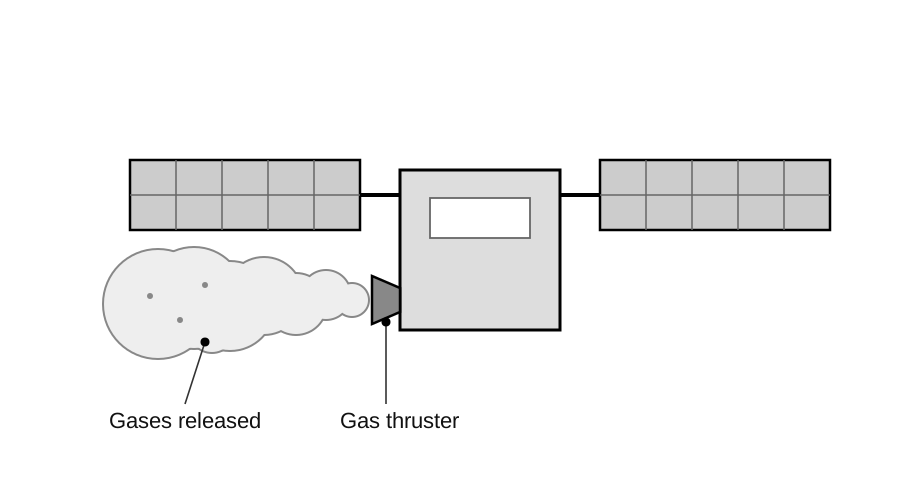
Compare the force of gravity on the satellite in the two orbits.
Our own questions on this topic, marked straight away, so you see what to revise. Free now.
Show model answer for 09.1Hide model answer for 09.1
Gravity is a little stronger in the first orbit, and a little weaker in the new one, because the force gets weaker as the distance from the Earth grows.
How the marks are earned
- The force of gravity is weaker in the new, higher orbit, or stronger in the original orbit. The comparison alone earns the mark; adding that the satellite is closer to the Earth in the original orbit is not needed.
Explain how the satellite's speed in the new orbit differs from its speed in the first orbit.
See how you would score on OrbitsShow model answer for 09.2Hide model answer for 09.2
The satellite moves more slowly in the new orbit.
This is because the new orbit has a larger radius. The pull of gravity is weaker there, so a smaller speed is enough to keep the satellite on a circular path.
How the marks are earned
- One mark: the speed in the new orbit is lower. The opposite statement, that the speed was higher in the original orbit, is accepted.
- One mark: the orbit now has a bigger radius. Saying only that the satellite is farther away or higher up, or that the distance or height has grown, or mentioning centripetal force or the circumference of the orbit, earns nothing.
Why it scores
This earns the first mark. A stable orbit at a different height needs a different speed.
This earns the second mark. For a stable circular orbit, the larger the radius, the lower the speed. Saying only that it is further away, or that the distance has grown, is not enough.
Revise OrbitsGive the reason a satellite going steadily round a circle is still accelerating.
See how you would score on OrbitsShow model answer for 09.3Hide model answer for 09.3
The satellite's direction of travel keeps changing as it goes round the circle.
Velocity is speed in a given direction, so a changing direction means a changing velocity, and a changing velocity is an acceleration, even when the speed stays the same.
How the marks are earned
- One mark: the direction of the satellite's motion keeps changing.
- One mark: so its velocity keeps changing, which means it is accelerating. Saying the velocity increases or decreases, or only mentioning gravity or speed, earns nothing.
Why it scores
This earns the first mark. Moving in a circle means turning all the time.
This earns the second mark. Acceleration is a change in velocity, not only a change in speed.
Revise OrbitsThe satellite's momentum is 9 144 000 kg m/s and its mass is 1200 kg. Find its velocity in m/s.
See how you would score on MomentumShow model answer for 09.4Hide model answer for 09.4
Rearrange for the velocity:. momentum = mass × velocity. velocity = momentum over mass
Substitute:. velocity = 9 144 000 over 1200
Work it out:. v = 7620 m/s
How the marks are earned
- One mark: choose momentum = mass × velocity. A correct substitution also earns this mark.
- One mark: rearrange and substitute: velocity = 9 144 000 ÷ 1200.
- One mark: the velocity, 7620 m/s.
- The correct answer, 7620 m/s, on the answer line earns full marks.
Why it scores
This earns the equation mark. It needs rearranging to make the velocity the subject.
This earns the substitution mark.
9 144 000 ÷ 1200 = 7620. The right answer alone earns all 3 marks.
Revise Momentum