Why Skydivers Don't Keep Getting Faster
💪 Why Skydivers Don't Keep Getting Faster
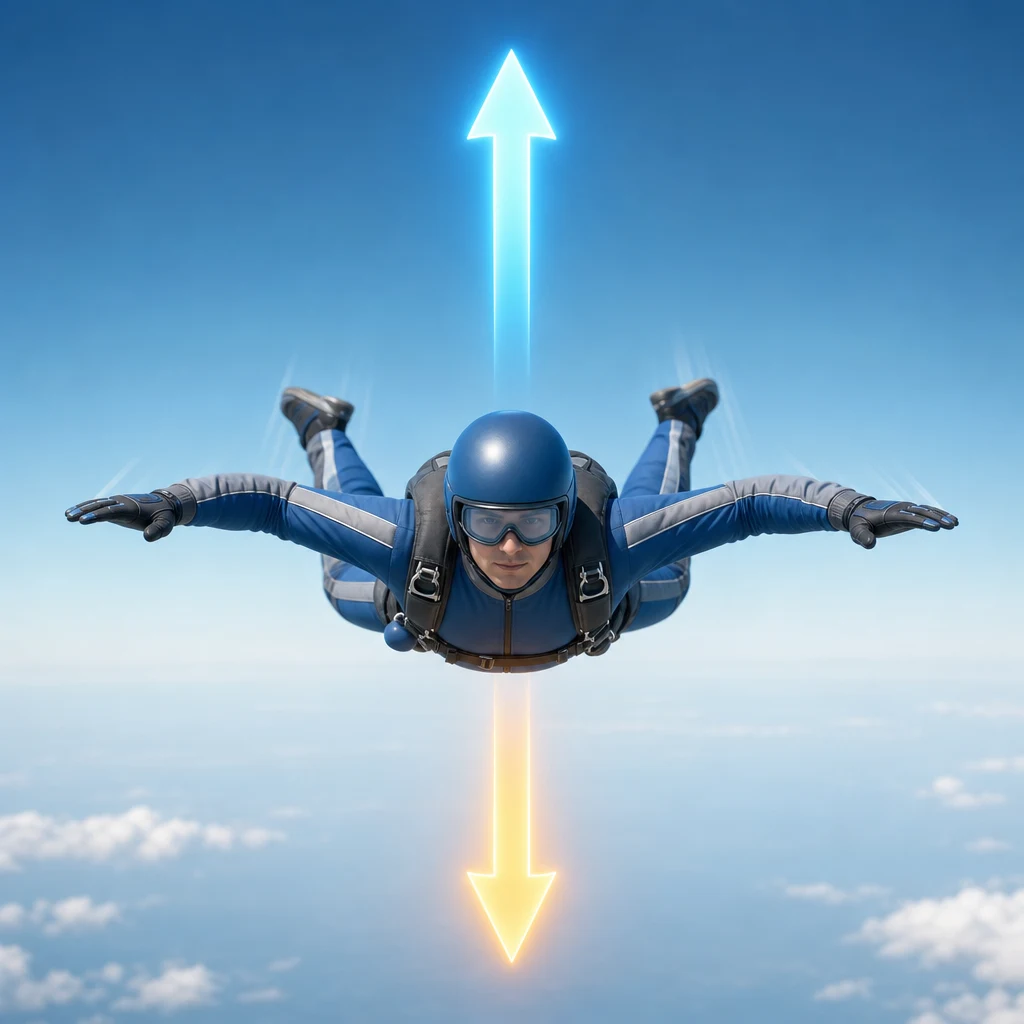
Figure 1: At terminal velocity the upward air resistance (cyan) exactly balances the downward weight (amber) — equal arrows mean zero resultant force, so the velocity stops changing.
Jump from a plane at 4,000 metres and something remarkable happens. For the first few seconds you accelerate furiously — stomach in your mouth, wind roaring past. But after about 12 seconds you notice something strange: you stop speeding up. You're still falling at roughly 55 m/s (about 120 mph), but the acceleration has gone. You've reached terminal velocity.
The secret is air resistance. The faster you fall, the harder the air pushes back up against you. Eventually the upward air resistance exactly equals your downward weight. At that moment the resultant force becomes zero — and Newton's First Law takes over: no resultant force means no change in velocity. You carry on at a constant, terrifying 55 m/s.
Open your parachute and the game changes instantly. The huge canopy dramatically increases your surface area. Air resistance rockets up, far exceeding your weight. You decelerate sharply until a new, much lower terminal velocity of about 5 m/s is reached — just enough for a safe landing.
Understanding terminal velocity is really about tracking two forces and how they change relative to each other as speed increases.
Earn the mark scheme marks
🧠 Memory Aids
The "Balanced Forces = Terminal" Rule
Think of a set of scales. When weight is on one side and drag is on the other, the object accelerates as long as the weight side is heavier. Terminal velocity is when the scales balance exactly — both pans level. No resultant force, no acceleration.
Velocity-Time Graph Shapes — GCSE Acronym
For a falling object reaching terminal velocity, the shape of the v-t graph goes through these stages:
S-F-H — Steep (high acceleration at start), Flattening curve (decreasing acceleration), Horizontal line (terminal velocity, zero acceleration)
What Raises vs Lowers Terminal Velocity
Think of it as a tug-of-war between weight and drag:
- More Weight → Wins the tug → terminal velocity goes UP
- More Drag (bigger area, less streamlined) → Damps the fall → terminal velocity goes DOWN
Quick Check: Explain why opening a parachute causes a skydiver to decelerate. Use the concept of forces in your answer.
Opening the parachute dramatically increases the surface area. This greatly increases the drag force. Drag now exceeds weight, so the resultant force acts upward (opposing motion). By Newton's Second Law (F = ma), this upward resultant force causes upward acceleration — which means the skydiver decelerates. The skydiver slows down until a new, lower terminal velocity is reached where drag once again equals weight.
Now try it yourself
Quiz · Question 1 of 13
An object reaches terminal velocity when falling through air. Which statement correctly describes the forces at terminal velocity?
Tap an answer to check it
This topic in real past papers
Every real exam question we've found on terminal velocity, with a full worked answer.