Particle ModelDiagram

Particle Arrangement in Three States

Part of States of MatterGCSE Physics

This diagram covers Particle Arrangement in Three States within States of Matter for GCSE Physics. Revise States of Matter in Particle Model for GCSE Physics with 13 exam-style questions and 30 flashcards. This is a high-frequency topic, so it is worth revising until the explanation feels precise and repeatable. It is section 2 of 13 in this topic. Focus on the labels, the relationships between parts, and the explanation that turns the diagram into an exam-ready answer.

Topic position

Section 2 of 13

Practice

13 questions

Recall

30 flashcards

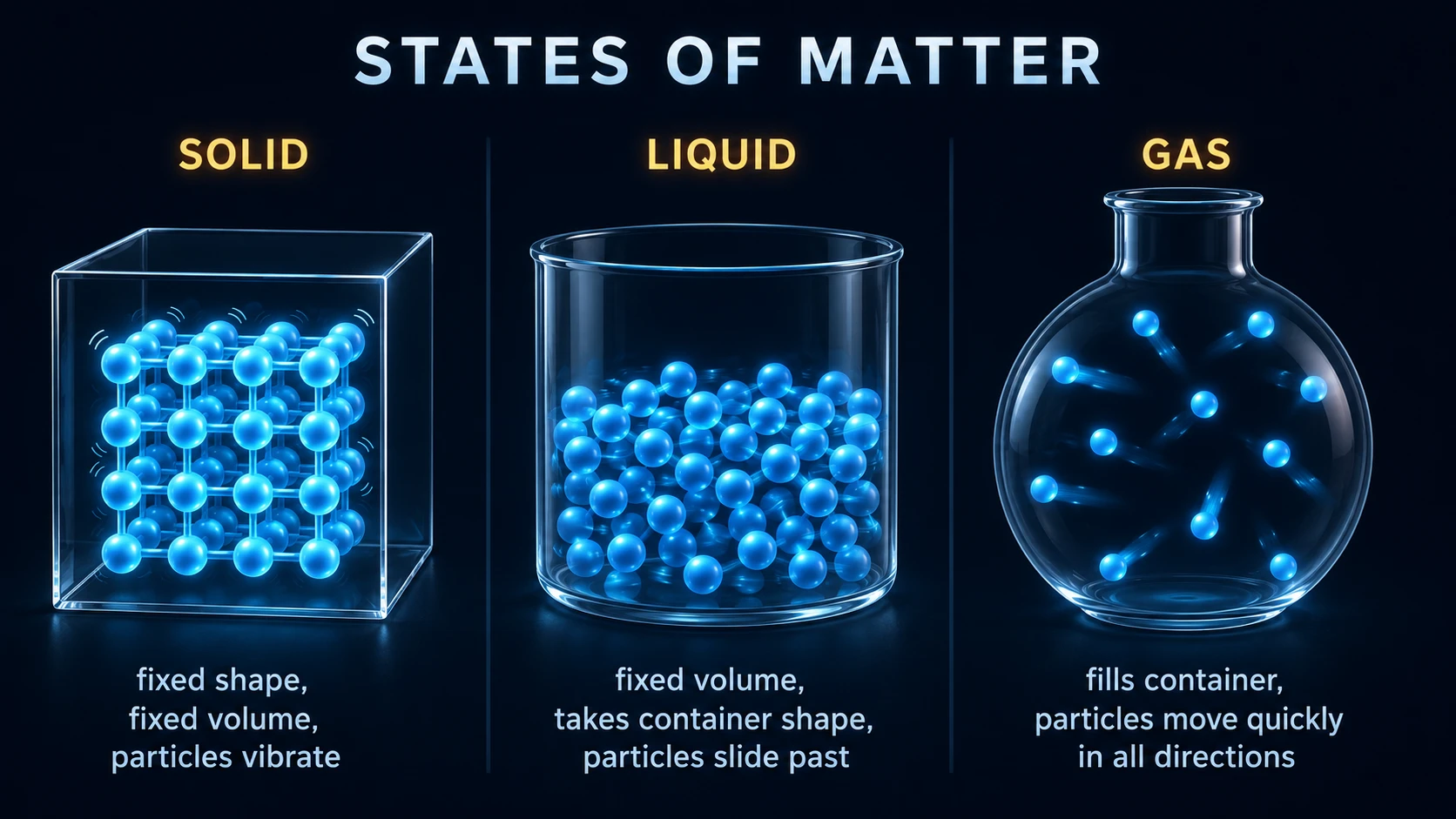
📊 Particle Arrangement in Three States

Particle arrangement in solids (fixed grid, vibrating), liquids (close but moving), and gases (spread out, fast random motion)

Figure 1: Particle arrangement and movement in solid, liquid, and gas states.

Keep building this topic

Read this section alongside the surrounding pages in States of Matter. That gives you the full topic sequence instead of a single isolated revision point.

Practice Questions for States of Matter

In which state of matter are particles arranged in a regular pattern and only vibrate about fixed positions?

  • A. Solid
  • B. Liquid
  • C. Gas
  • D. Plasma
1 markfoundation

Explain what happens to the particles in a solid when it is heated until it melts. Include what happens to the temperature during melting.

3 marksstandard

Quick Recall Flashcards

Particles in solid?
Regular pattern, vibrate in fixed positions
Particles in gas?
Random, far apart, fast in all directions

Want to test your knowledge?

PrepWise has 13 exam-style questions and 30 flashcards for States of Matter — with adaptive difficulty and instant feedback.

Join Alpha