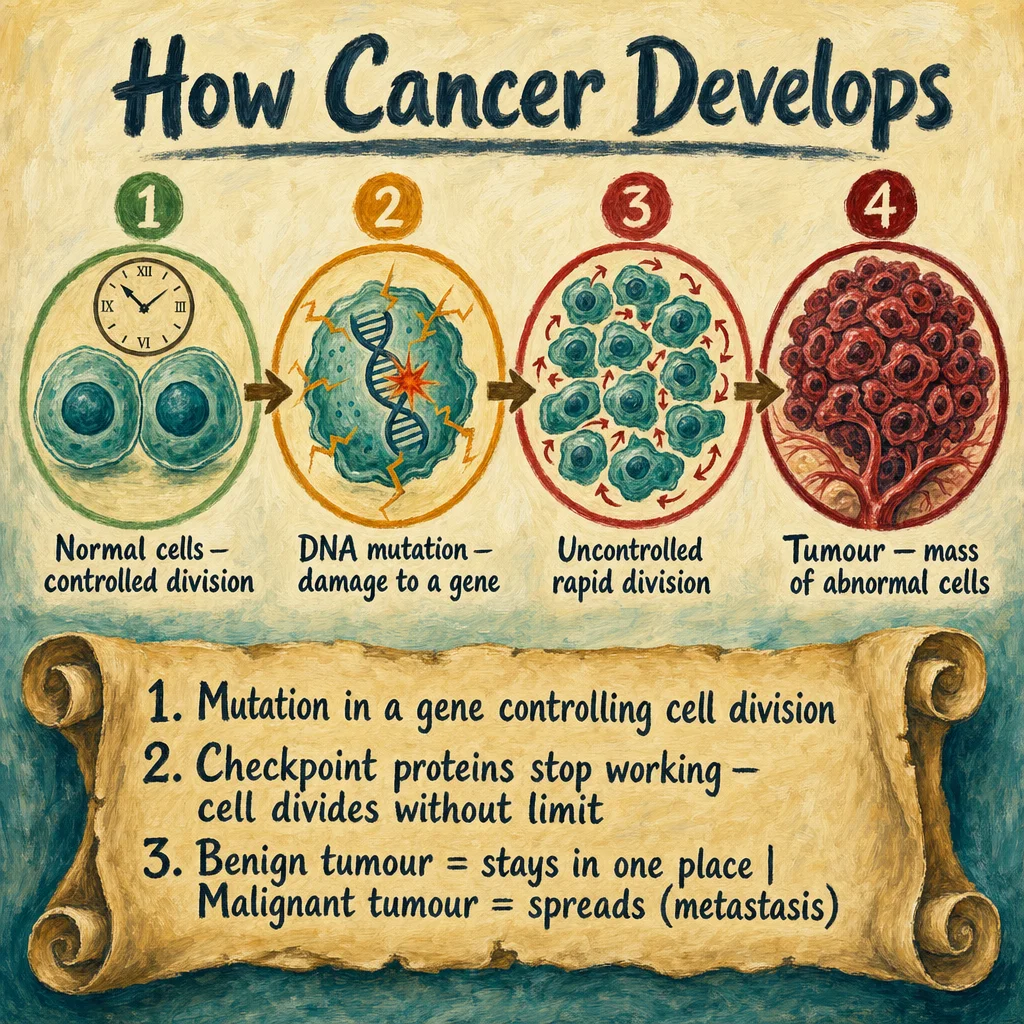
Figure: The step-by-step development of cancer from a single mutated cell to metastatic disease.
This diagram covers Cancer Development Process within Cancer and Cell Division Control for GCSE Biology. Cancer development, cell cycle control mechanisms, tumor formation, risk factors, prevention methods, and treatment approaches It is section 6 of 18 in this topic. Focus on the labels, the relationships between parts, and the explanation that turns the diagram into an exam-ready answer.
Practice questions for Cancer and Cell Division Control
In a healthy cell, cell division is controlled by:
Explain the difference between benign and malignant tumors.
Quick recall flashcards
Name three environmental carcinogens.
Tobacco smoke, UV radiation from sunlight, and asbestos fibers. (Also accept: ionizing radiation, benzene, formaldehyde, etc.)
What is cancer?
Cancer is a group of diseases involving uncontrolled cell division, where cells divide continuously without normal restrictions.