The Story: The Survival of the Fittest
The Story: The Survival of the Fittest
Charles Darwin spent 5 years on HMS Beagle, observing nature. He noticed that individuals vary, and those with advantages survive better and reproduce more. Over generations, this leads to evolution — gradual change in species. His idea was controversial in 1859 but is now the foundation of biology!
Natural selection in action. Click each dot to explore variation, predation, camouflage, inheritance, and population change over generations.
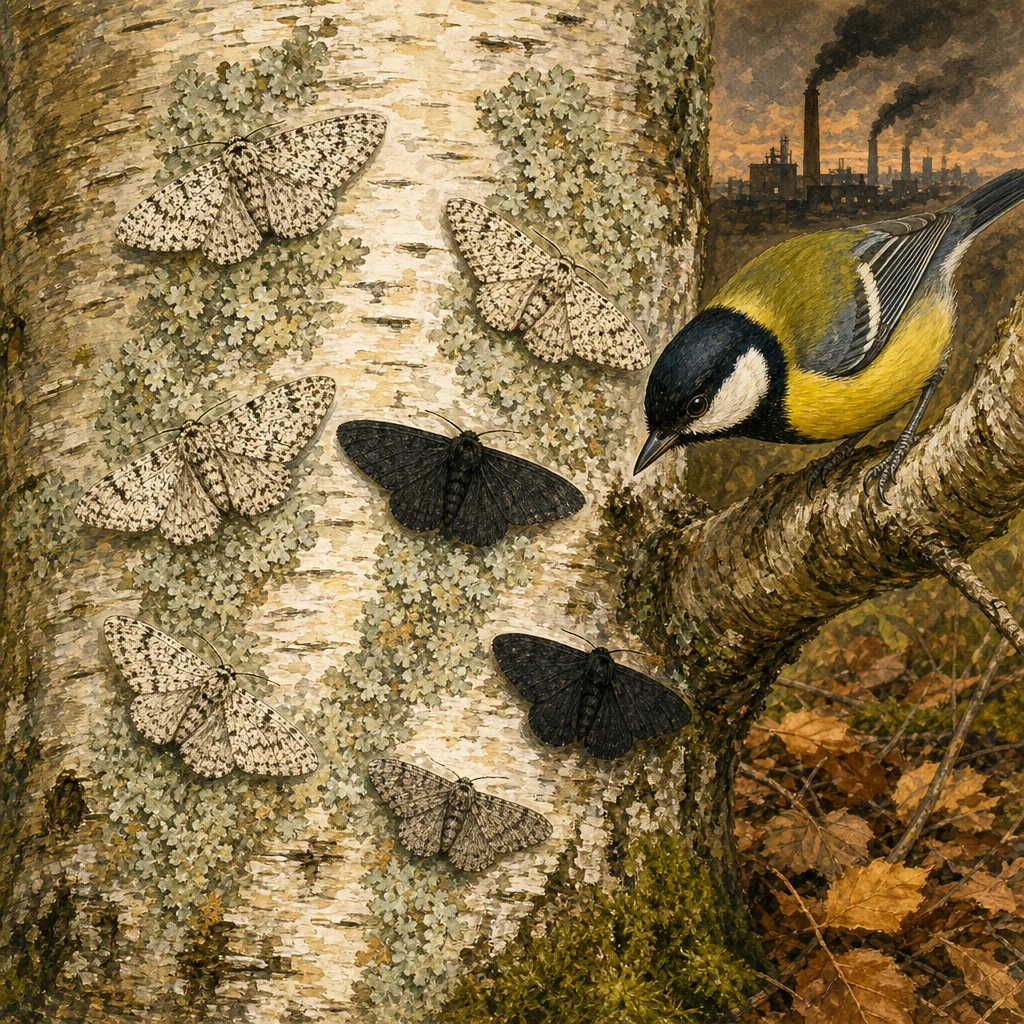
- 1Variation in the population —
- 2Predation as selection pressure —
- 3Camouflage as an adaptation —
- 4Survivors pass on alleles —
- 5Population changes over generations —
Natural selection in action. Click each dot to explore variation, predation, camouflage, inheritance, and population change over generations.
Biology glossary
- What is evolution?
- The gradual change in the inherited characteristics of a population over many generations through the process of natural selection. It can lead to new species forming over very long time periods.
Natural selection is like a survival competition. Those with the best "skills" (adaptations) survive and have kids. Those kids inherit the winning traits. Over many generations, the population becomes better suited to its environment.
Earn the mark scheme marks
Memory Aids
VISA — The four steps of natural selection:
"You need a VISA to get through the environment."
- V — Variation (individuals differ)
- I — Inheritance (traits passed to offspring)
- S — Selection (environment favours some individuals)
- A — Accumulation (advantageous alleles increase over generations)
Darwin vs Lamarck — spot the difference:
- Lamarck: Organism changes during its lifetime → passes the change on. (WRONG)
- Darwin: Random variation already exists → selection acts on it. (CORRECT)
- Memory trick: "Lamarck = Learned traits passed on. Darwin = Born different, best survive."
Evolution = population change, not individual change:
"One giraffe does not grow a longer neck. The POPULATION ends up with longer necks."
Quick Check: A population of beetles lives on green leaves. Most are green, but some are brown. Birds eat beetles. Explain, using natural selection, how this population could become mostly brown if the leaves dried out and turned brown.
Initially most beetles are green — they are well camouflaged and survive easily. Brown beetles are poorly camouflaged against green leaves and are more likely to be eaten by birds. When the leaves turn brown, the selection pressure reverses: brown beetles are now better camouflaged and more likely to survive and reproduce. Brown beetles pass on the allele for brown colouration to their offspring. Over many generations, the proportion of brown beetles in the population increases (the frequency of the brown allele rises) while the proportion of green beetles decreases. Eventually the population is mostly brown.
Quick Check: A student says that a giraffe stretched its neck during its lifetime and passed on a longer neck to its offspring. Identify whose theory this represents and explain the scientific evidence that disproves it.
This represents Lamarck's theory of inheritance of acquired characteristics. It is disproved by our understanding of genetics: characteristics are determined by alleles in DNA. Physical changes to an organism's body during its lifetime (such as muscle growth through exercise, or stretching) do not alter the DNA in gametes. Therefore, acquired characteristics cannot be inherited. Darwin's theory of natural selection — random variation already present in the population, acted on by selection — is supported by the fossil record, observed evolution of antibiotic resistance, and DNA evidence.
Quick Check: Explain why a single mutation that gives one bacterium antibiotic resistance can lead to the entire bacterial population becoming resistant within a short period of time.
The bacterium with the resistance mutation is better adapted to survive in the presence of the antibiotic. When the antibiotic is used, it kills all non-resistant bacteria, leaving only the resistant bacterium alive. This bacterium reproduces rapidly (bacteria can divide every 20 minutes) and all its offspring inherit the resistance allele. With no competition from non-resistant bacteria (which have been killed), the resistant population grows exponentially. Within hours to days, the entire population can consist of resistant bacteria. This is an example of natural selection operating over an extremely short timescale due to the short generation time of bacteria.
Now try it yourself
Quiz · Question 1 of 29
What is evolution?
Tap an answer to check it
This topic in real past papers
Every real exam question we've found on evolution, with a full worked answer.
AQA Paper 2
Explain how a population evolved a new trait through natural selection, or explain how fossil evidence and genetics have both shaped our understanding of evolution
Edexcel Paper 1
Explain natural selection, the risk of low genetic diversity, and evidence for evolution from limb structure