Your Body's Power Station
🔋 Your Body's Power Station
Imagine your body as a city that never sleeps. Every cell is a building that needs electricity — for lights, heating, machinery, and communication. Where does all that power come from? Respiration is your body's power station: it takes glucose (the fuel) and converts it into ATP (the electricity) that every cell needs to function. Just like a real power station burns fuel to generate electricity, your cells "burn" glucose to release energy — and just like a power station, they produce waste gases (CO₂) and heat in the process.
Inside a mitochondrion — the folded inner membrane gives a large surface area for aerobic respiration; the matrix holds the enzymes that drive it.
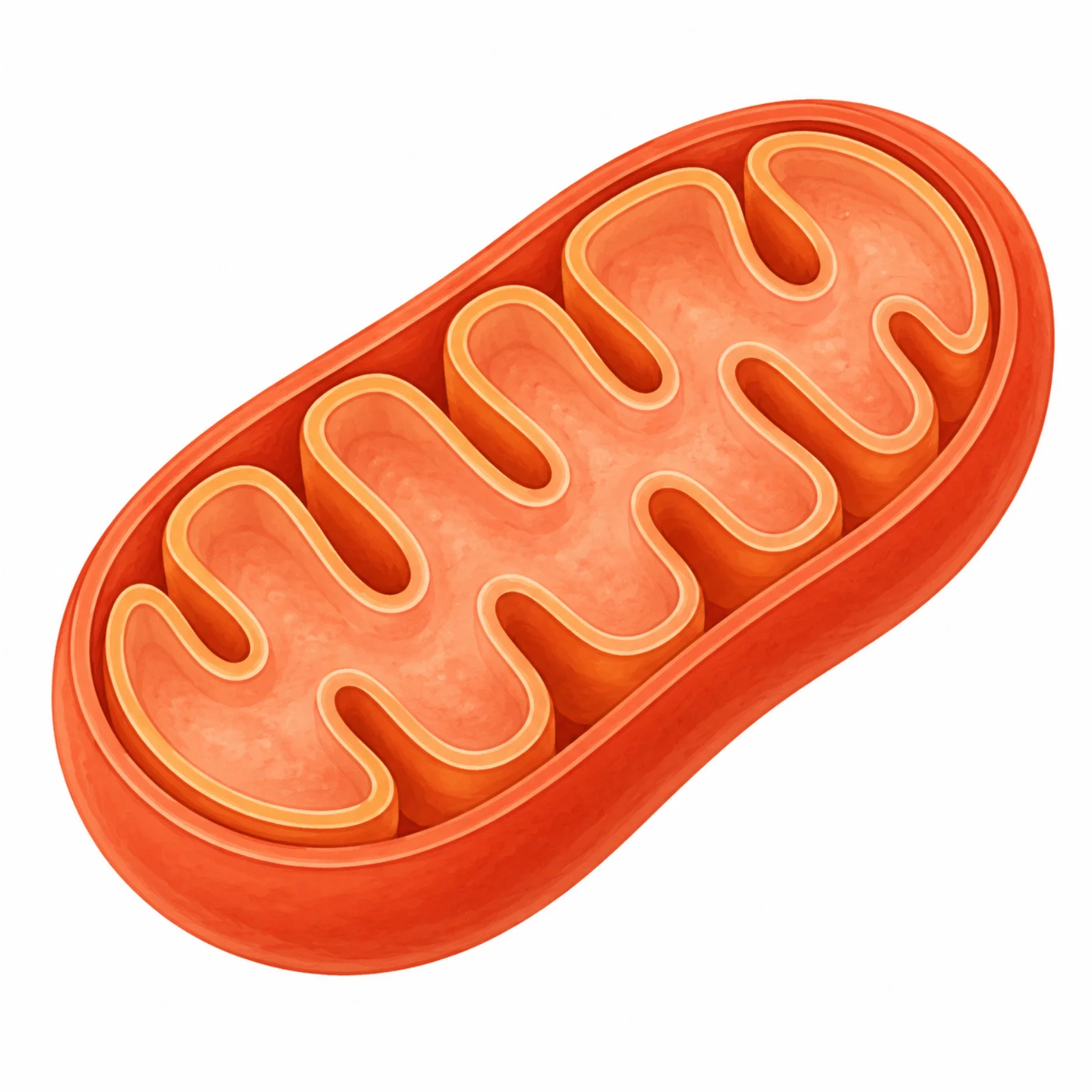
- 1Outer membrane — The smooth outer boundary — controls what enters and leaves.
- 2Inner folded membrane — Heavily folded — the folds give a large surface area for respiration reactions.
- 3Matrix — The fluid inside — where the chemistry of aerobic respiration happens.
Figure 1: Inside a mitochondrion — the folded inner membrane gives a large surface area for aerobic respiration; the matrix holds the enzymes that drive it.
Aerobic respiration is the primary way your cells release energy from glucose. It requires oxygen and takes place in the mitochondria — the organelles often called the "powerhouses" of the cell.
Earn the mark scheme marks
🧠 Memory Aids
Aerobic respiration equation:
Word equation: glucose + oxygen → carbon dioxide + water (+ energy)
Mnemonic: "GOD Cuts Wood — Glucose + Oxygen → CO2 + Water"
(G=Glucose, O=Oxygen → D=Carbon Dioxide [CO2], C=Carbon, W=Water)
Aerobic vs Anaerobic — the KEY differences table:
| Feature | Aerobic | Anaerobic (animals) | Anaerobic (yeast/plants) |
|---|---|---|---|
| Oxygen needed? | Yes | No | No |
| Products | CO2 + H2O | Lactic acid | Ethanol + CO2 |
| Energy (ATP) yield | High (~36-38 ATP) | Low (2 ATP) | Low (2 ATP) |
| Site | Mitochondria | Cytoplasm | Cytoplasm |
| Sustainable for? | Long periods | Short bursts | Hours-days |
Oxygen debt — ALCE:
- A — Anaerobic respiration during exercise produces lactic acid
- L — Lactic acid builds up in muscles (fatigue and pain)
- C — Continued heavy breathing after exercise (the "debt")
- E — Extra oxygen oxidises lactic acid in the liver back to CO2 and H2O
Quick Check: A 100-metre sprinter crosses the finish line breathing very heavily, even though the race lasted only 10 seconds. Their breathing rate remains elevated for several minutes after the race ends. Explain, using your knowledge of respiration, why the sprinter continues to breathe rapidly after the race is over.
During the sprint, the muscles required energy faster than the cardiovascular system could deliver oxygen. The muscles switched to anaerobic respiration (glucose → lactic acid), which produced ATP to keep muscles contracting but also caused lactic acid to build up in the muscles and blood. After the race, the sprinter continues to breathe heavily to take in extra oxygen above the resting requirement. This extra oxygen is used to: (1) repay the oxygen debt by transporting lactic acid to the liver, where it is converted back into glucose (an aerobic process requiring oxygen), and (2) restore oxygen levels in the blood and muscle tissue to their pre-exercise levels. The elevated breathing rate persists until the lactic acid has been fully processed and the oxygen debt is repaid.
Quick Check: A student says: "Yeast produces the same waste products as exercising muscle cells during anaerobic respiration." Evaluate this statement. Is it correct? Justify your answer with reference to the relevant equations.
The statement is incorrect. Yeast and exercising muscle cells follow different anaerobic pathways and produce different products. In exercising animal muscle cells, anaerobic respiration produces lactic acid: glucose → lactic acid. In yeast cells, anaerobic respiration (fermentation) produces ethanol and carbon dioxide: glucose → ethanol + carbon dioxide. Both pathways start with glucose and both occur without oxygen, but the end products are completely different. A correct statement would be: "Both yeast and muscle cells carry out anaerobic respiration, but the products differ — muscle cells produce lactic acid, while yeast produces ethanol and carbon dioxide."
Quick Check: A student measures the body temperature of a person at rest and again immediately after vigorous exercise. They find the temperature has risen from 37.0°C to 37.8°C. Explain why body temperature increases during exercise, linking your answer to the nature of the respiration reaction.
Aerobic respiration is an exothermic reaction — it releases energy from glucose, and not all of this energy is transferred usefully to ATP. A significant proportion is released as heat energy. During vigorous exercise, muscles are contracting rapidly and require large amounts of ATP, so the rate of aerobic respiration in muscle cells increases dramatically. This greatly increases the rate of heat release. The heat is transferred to the blood and distributed around the body, raising core body temperature. The body's thermoregulatory system (sweating and vasodilation) works to counteract this rise, but during intense short-duration exercise, heat production can temporarily outpace heat loss, causing the temperature to rise measurably.
Now try it yourself
Quiz · Question 1 of 29
Where in the cell does aerobic respiration take place?
Tap an answer to check it
This topic in real past papers
Every real exam question we've found on respiration, with a full worked answer.