The Cell's Transport System
🚗 The Cell's Transport System
Imagine a bustling city where millions of residents need food, water, and supplies delivered to their homes, while waste needs to be removed. Cells face the same challenge! Every cell needs nutrients like glucose and oxygen to survive, while waste products like carbon dioxide must be expelled.
Cells have evolved three main transport systems to move substances in and out: diffusion (like people naturally spreading out in a crowded room), osmosis (the special movement of water), and active transport (using energy to move things uphill). Understanding these processes is crucial for GCSE Biology - they appear in virtually every biological system you'll study!
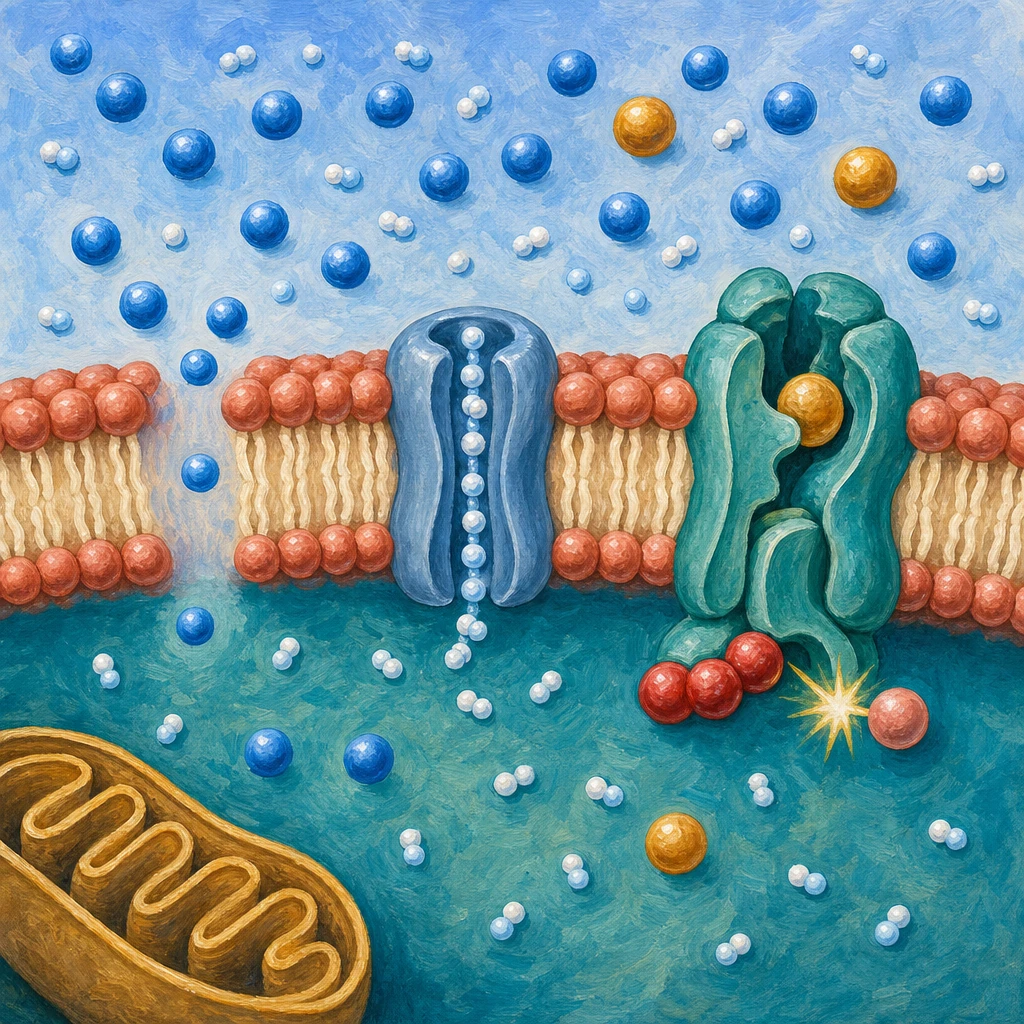
- 1Diffusion — Particles spreading from crowded to less crowded — no energy needed
- 2Osmosis — Water's one-way door — through the partially permeable membrane
- 3Active transport — Pumping uphill — moving substances against the gradient using ATP
- 4Concentration gradient — The difference in concentration that drives passive transport
- 5ATP energy — The cell's energy currency — only active transport spends it
Biology glossary
- Define osmosis
- The movement of water molecules from an area of high water concentration (low solute concentration) to an area of low water concentration (high solute concentration) through a semi-permeable membrane.
- Define diffusion
- The movement of particles from an area of high concentration to an area of low concentration down a concentration gradient. No energy is required (passive process).
Definition: Movement of particles from high concentration to low concentration
Earn the mark scheme marks
💡 Memory Aid: DOA
Use the acronym DOA to remember the three transport types and their key features:
| Letter | Process | Key Feature | Energy? |
|---|---|---|---|
| D | Diffusion | Down the gradient (high → low), any particle | No |
| O | Osmosis | Only water, through partially permeable membrane | No |
| A | Active transport | Against the gradient (low → high), needs ATP | Yes |
Additional Mnemonics
- Osmosis = O — "O" looks like water droplets. Osmosis = water ONLY. "O for Only water."
- Active = Against — Both start with "A". Active transport goes Against the gradient.
- Turgid, Flaccid, Plasmolysed — "The Full Plant Plays" → Turgid (full of water), Flaccid (limp), Plasmolysed (pulled away from wall).
- Percentage change formula — "Final minus Initial, divided by Initial, times 100." Think: "FI-I over I times 100."
Quick Check: Explain why a lettuce leaf placed in salty water becomes limp and wilts. Use the terms osmosis, partially permeable membrane, concentration gradient, and flaccid in your answer.
The salty water has a lower water concentration (higher solute concentration) than the cytoplasm inside the lettuce cells. Water therefore moves by osmosis — through the partially permeable cell membrane — down the water concentration gradient, out of the cells and into the salty solution. As the cells lose water, their vacuoles shrink and they become flaccid (limp). With no turgor pressure pushing against the cell walls, the leaf loses its rigidity and wilts.
Now try it yourself
Quiz · Question 1 of 23
Which statement best describes diffusion?
Tap an answer to check it
This topic in real past papers
Every real exam question we've found on cell transport, with a full worked answer.