The Blueprint of Life
The Blueprint of Life
Imagine a library containing every instruction needed to build and run your body — from your eye colour to how tall you'll grow. This "library" exists in almost every cell in your body. It's called your genome, and it's written in a chemical language called DNA. Just 4 "letters" (A, T, C, G) combine in different orders to create all the diversity of life on Earth!
DNA structure. Tap any dot to see what each part does — close-ups for the helix, base pair, and backbone.
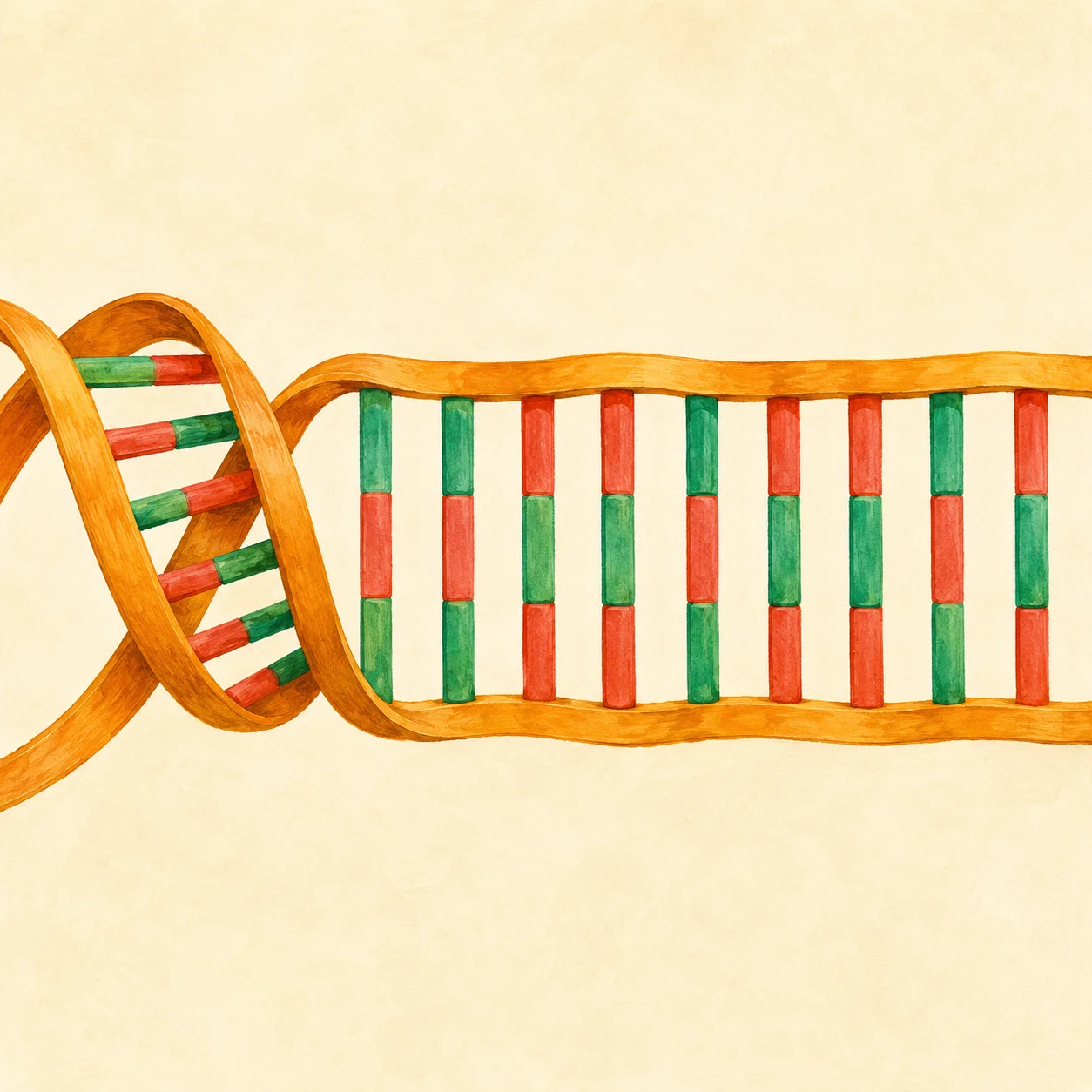
- 1Double helix — The iconic twisted-ladder shape of DNA — two strands spiralling around each other.
- 2Sugar-phosphate backbone — The outer rails of the ladder — alternating sugar and phosphate units that form each strand.
- 3Base pair — Two bases on opposite strands that fit together — A pairs with T, C pairs with G.
- 4Nucleotide — The building block of DNA — one sugar, one phosphate, and one base joined together.
- 5Gene — A short section of DNA that codes for one specific protein.
Figure 1: DNA structure. Tap any dot to see what each part does — close-ups for the helix, base pair, and backbone.
Biology glossary
- What is a gene?
- A section of DNA that codes for the production of a specific protein. The sequence of bases in the gene determines which protein is made.
- What is an allele?
- A different version of the same gene. For example, the gene for eye colour has alleles for brown eyes and blue eyes. Alleles arise due to mutations in the original gene.
DNA is your body's recipe book. The genome is the whole book. Chromosomes are chapters. Genes are individual recipes. The bases (A, T, C, G) are the letters that spell out each recipe. Different recipes (genes) make different proteins!
Earn the mark scheme marks
Memory Aids
Complementary base pairing — "All Tigers Can Growl": Adenine-Thymine, Cytosine-Guanine. The two pairs that always bond together. AT bonds have 2 hydrogen bonds; CG bonds have 3 — but you only need to know which letters pair, not how many bonds.
The hierarchy — NCGP: Nucleus contains Chromosomes, which contain Genes, which are sections of the Polymer (DNA). From largest to smallest: nucleus → chromosome → gene → DNA base sequence.
Genome = "the entire genetic library": Every book in the library = genome. Each shelf (chromosome) holds many books (genes). Each book is written in the same 4-letter alphabet (A, T, C, G).
DNA structure mnemonic — "A-T Pairs, C-G Clings": Adenine with Thymine (2 hydrogen bonds), Cytosine with Guanine (3 hydrogen bonds). Or simply: A=T and C≡G.
Protein synthesis order — "The Nuclear Photocopier": DNA stays in the Nucleus. The mRNA photocopy travels out through Nuclear pores to the Ribosome. Remember: Transcription (T = in nuclEus) then Translation (T = at Ribosome). Two T's, two locations.
What mRNA uses instead of T: "mRNA swaps T for Tea (U)" — Uracil sounds like "you-racil" and it replaces thymine in RNA. A still pairs with U on mRNA, just as A pairs with T on DNA.
Mutation outcomes — "NHS": Most mutations are Neutral (silent), some are Harmful (e.g., sickle cell), rarely they are Somehow beneficial (e.g., antibiotic resistance).
Quick Check: A scientist discovers a section of DNA that codes for the enzyme amylase. Explain, step by step, how the base sequence of this DNA section determines the structure and function of the amylase enzyme.
The base sequence of the gene determines the order in which amino acids are assembled. Groups of three bases (codons) each specify a particular amino acid. Ribosomes read the copied message (mRNA) and join amino acids together in the order coded by the gene. The resulting chain of amino acids folds into a specific 3D shape — the active site of amylase. The precise shape of the active site determines which substrate (starch) can bind to it, so the base sequence of the gene ultimately determines the enzyme's specific function.
Quick Check: Two organisms have different phenotypes for the same characteristic. Explain how differences in DNA base sequence can lead to differences in phenotype.
Different base sequences in a gene code for different orders of amino acids. Different amino acid sequences produce proteins that fold into different 3D shapes. Different protein shapes mean different functions — for example, different enzyme shapes produce different pigments, or different structural proteins produce different tissue properties. These differences at the molecular level manifest as observable differences in phenotype (physical characteristics).
Quick Check: A student states that the genome of a muscle cell and the genome of a skin cell from the same person are different. Evaluate this statement.
The statement is incorrect. The genome (all of the DNA) in both cell types is identical, because both cells descended from the same fertilised egg by mitosis, which copies DNA exactly. What differs between muscle cells and skin cells is gene expression — different genes are switched on in each cell type, which is why they produce different proteins and have different structures. The genome itself does not change; what changes is which parts of it are being read.
Now try it yourself
Quiz · Question 1 of 26
Which of the following base pairing rules is correct for DNA?
Tap an answer to check it
This topic in real past papers
Every real exam question we've found on dna genome, with a full worked answer.