The Ultimate Solar-Powered Factory
🌱 The Ultimate Solar-Powered Factory
Imagine a factory that runs entirely on sunlight, uses carbon dioxide as raw material, and produces both food and oxygen as output. Every green leaf on Earth is exactly that factory. Photosynthesis is the process that feeds virtually every living thing on the planet — and it all happens inside tiny organelles smaller than a grain of sand.
Inside a chloroplast — chlorophyll in the stacks absorbs light, and the stroma is where that light energy is used to build glucose.
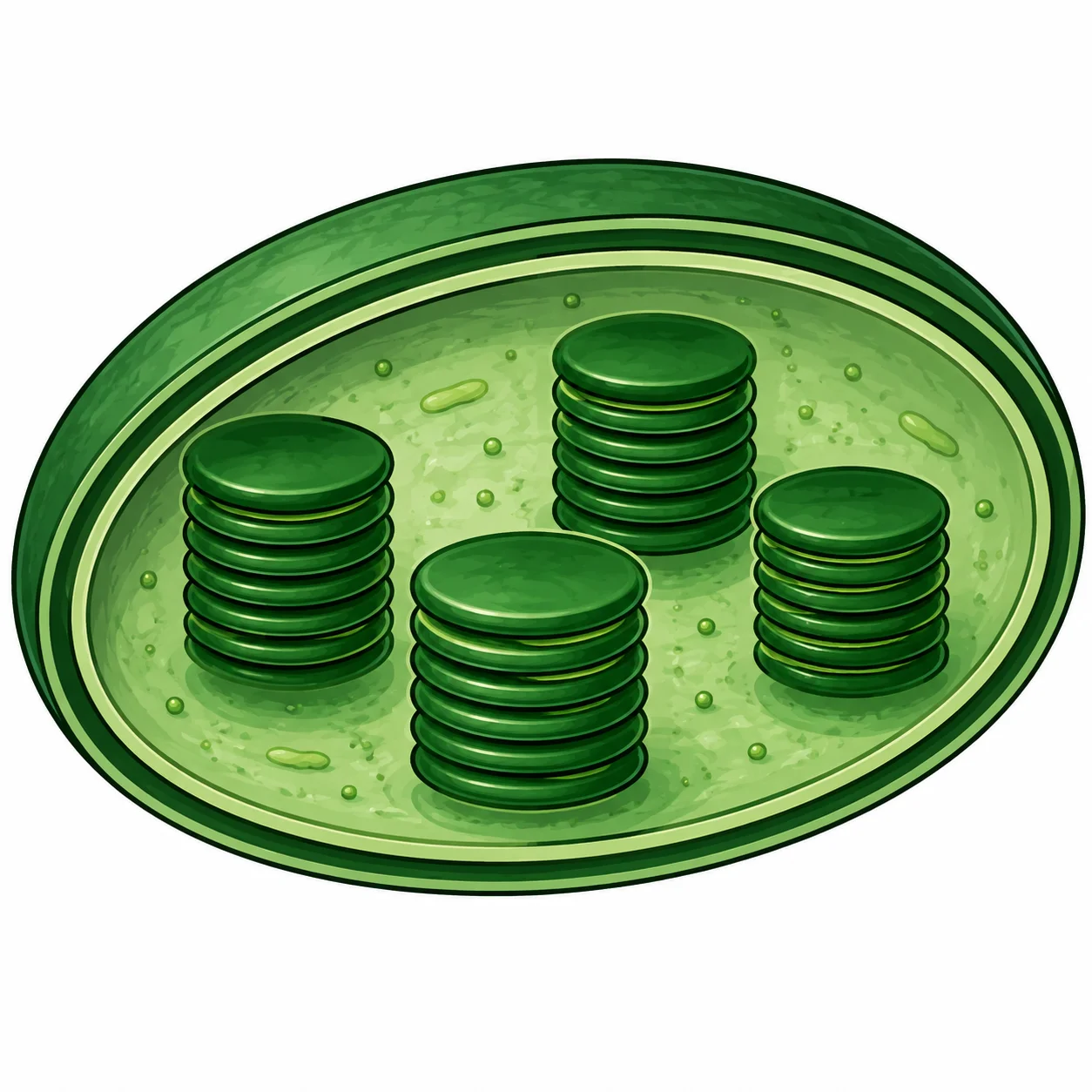
- 1Outer membrane — The double boundary — lets CO₂ in and O₂ out, while keeping the chloroplast's contents in place.
- 2Chlorophyll stacks — Stacks of disc-shaped membranes packed with chlorophyll — where light is absorbed.
- 3Stroma — The fluid surrounding the stacks — where glucose is built from CO₂.
Figure 1: Inside a chloroplast — chlorophyll in the stacks absorbs light, and the stroma is where that light energy is used to build glucose.
Photosynthesis is the process by which plants use light energy to convert carbon dioxide and water into glucose and oxygen. Word equation: carbon dioxide + water → glucose + oxygen. Symbol equation: 6CO₂ + 6H₂O → C₆H₁₂O₆ + 6O₂ (requires light energy). It occurs in the chloroplasts, which contain the green pigment chlor
Earn the mark scheme marks
Memory Aids
The photosynthesis equation — "Six CO2 plus six H2O, light makes glucose and six O2":
Written out: 6CO2 + 6H2O + light energy → C6H12O6 + 6O2
Say it as a rhythm: "Six carbon dioxide, six water, light goes in — glucose comes out, and six oxygen."
Limiting factors — COLT:
- C — CO2 concentration
- O — (O2 is produced, not a limiting factor — helps you remember what comes out)
- L — Light intensity
- T — Temperature
The three actual limiting factors are C, L, and T. If any one of them is too low, it will cap the rate no matter what the others are doing.
Uses of glucose — RSCLP:
- R — Respiration (release energy)
- S — Starch (stored in roots and seeds)
- C — Cellulose (cell walls)
- L — Lipids (oils and fats in seeds)
- P — Proteins (with nitrate ions from soil)
Endothermic vs exothermic: Photosynthesis takes energy IN (EN-dothermic, ENtering). Respiration lets energy OUT (EX-othermic, EXiting).
Quick Check: A gardener places a tomato plant on a windowsill and notices that doubling the brightness of a lamp shining on it from 1000 lux to 2000 lux increases the rate of photosynthesis. However, doubling it again from 2000 lux to 4000 lux produces no increase in rate. Explain what is happening at 2000 lux and identify what should be done to increase the rate further.
At 2000 lux, light is no longer the limiting factor — the plant is receiving more light than it can use. At this point, either CO2 concentration or temperature has become the new limiting factor. The rate is capped because one of these other variables cannot keep up with the light supply. To increase the rate further, the gardener should either increase the CO2 concentration around the plant (for example by adding more CO2 to a greenhouse) or increase the temperature (up to the optimum, around 25-30°C for most crop plants), depending on which is currently limiting. Simply adding more light will have no effect once it stops being the bottleneck.
Quick Check: A student uses an aquatic plant (Elodea) to investigate photosynthesis by counting the number of oxygen bubbles produced per minute at different distances from a lamp. At 10 cm from the lamp, 40 bubbles/min are produced. At 20 cm, only 10 bubbles/min are produced. Use the inverse square law to explain why the rate fell so dramatically despite the distance only doubling.
The inverse square law states that light intensity is inversely proportional to the square of the distance from the source: I is proportional to 1/d2. When the distance doubles from 10 cm to 20 cm, the light intensity does not halve — it falls to one quarter (1/22 = 1/4). So the plant at 20 cm receives only 25% of the light intensity it had at 10 cm. This is a four-fold reduction in light (the limiting factor), which explains why the bubble count fell from 40 to 10 — also a four-fold reduction. This relationship means that small changes in distance have large effects on light intensity, and the effect is not linear.
Quick Check: A commercial greenhouse manager wants to maximise the rate of photosynthesis in their crop year-round. The greenhouse is fitted with powerful lights and a heating system. In January, the manager measures the photosynthesis rate and finds it is the same despite turning on extra lights. Suggest two changes the manager should make and explain the reasoning behind each.
Since adding more light is not increasing the rate, light is not the limiting factor. The manager should: (1) Increase CO2 concentration — this is commonly done in commercial greenhouses by burning natural gas, which releases CO2 as a byproduct. Higher CO2 provides more substrate for the carbon-fixing reactions, so the rate can increase. (2) Check and potentially increase temperature — in January, even with heating, the temperature may be suboptimal (below the enzyme optimum of around 25-30°C). Raising temperature increases the kinetic energy of enzyme and substrate molecules, increasing the frequency of successful collisions and speeding up the reactions. Both changes address the actual limiting factor(s) rather than the one (light) that is already in excess.
Now try it yourself
Quiz · Question 1 of 31
Where does photosynthesis take place in plant cells?
Tap an answer to check it
This topic in real past papers
Every real exam question we've found on photosynthesis, with a full worked answer.