What each test detects
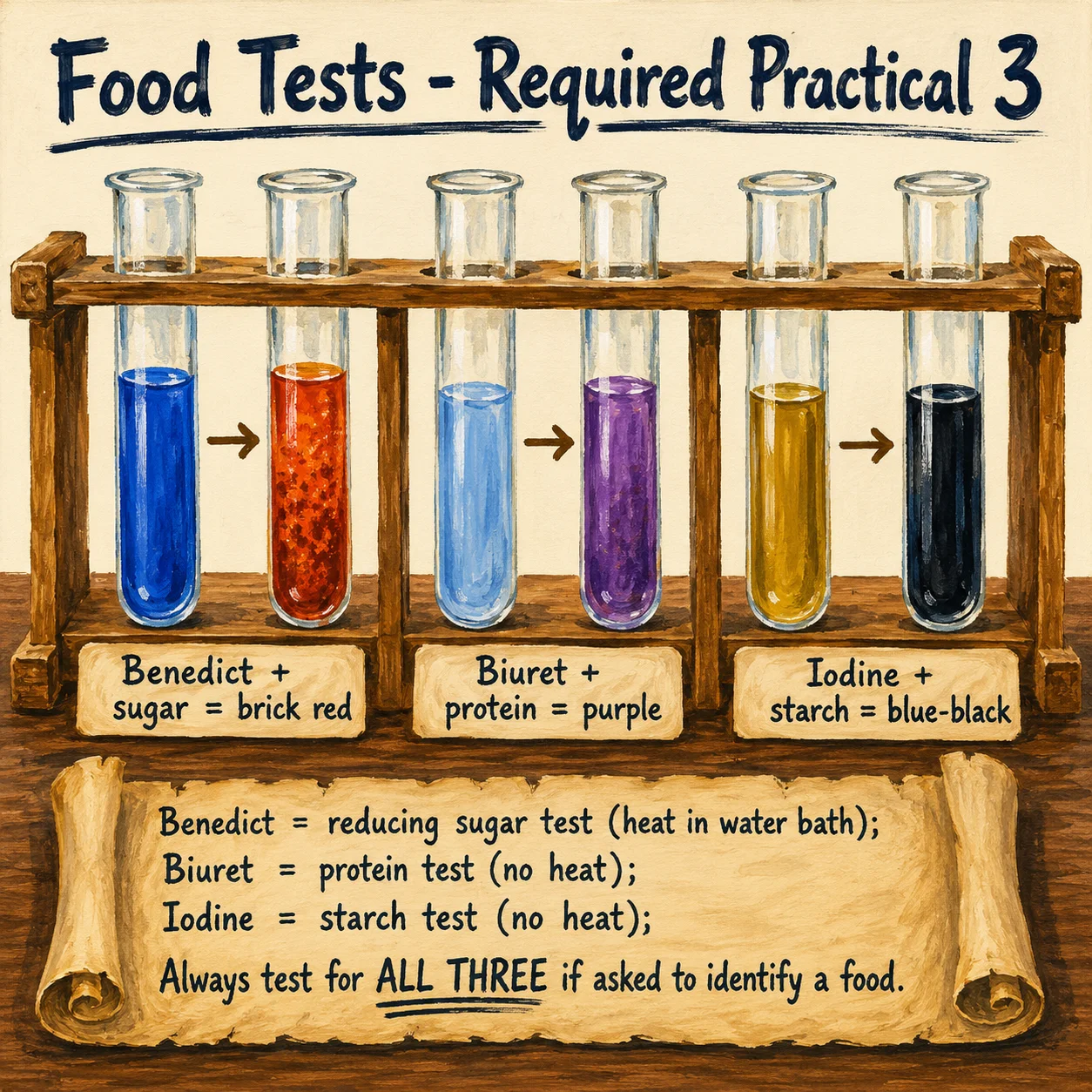
- Benedict's reagent — tests for reducing sugars (e.g. glucose). Heat the sample with Benedict's in a water bath. Positive result: blue → brick red. Negative: stays blue.
- Biuret reagent — tests for proteins. Add biuret to sample, no heating. Positive result: pale blue → purple/lilac. Negative: stays blue.
- Iodine solution — tests for starch. Add iodine to sample, no heating. Positive result: yellow-brown → blue-black. Negative: stays yellow-brown.
Exam tip
When asked to identify an unknown food, perform all three tests on separate samples. Examiners often give a food that contains MORE than one nutrient — students who only do one test miss marks. Also note the heating step: only Benedict's requires a water bath. Forgetting to heat Benedict's (or wrongly heating biuret/iodine) is a common mark-losing error.
This required practical covers Required Practical: Food Tests (Benedict's, Biuret, Iodine) within Cell Biology Practical Investigations for GCSE Biology. Comprehensive practical skills, experimental design, data analysis, microscopy techniques, and scientific methodology in cell biology It is section 6 of 18 in this topic. Revise both the method and the reason for each step, because practical questions often test understanding rather than pure recall.
Practice questions for Cell Biology Practical Investigations
When using a light microscope to observe cells, which objective lens should be used first?
Describe how to focus a light microscope on a specimen.