Cell BiologyDiagram

Stem Cell Differentiation — Source and Destination

Part of Stem Cells and Cell Differentiation · GCSE GCSE Biology revision

This diagram covers Stem Cell Differentiation — Source and Destination within Stem Cells and Cell Differentiation for GCSE Biology. Stem cell types, differentiation processes, therapeutic applications, embryonic vs adult stem cells, and ethical considerations It is section 2 of 17 in this topic. Focus on the labels, the relationships between parts, and the explanation that turns the diagram into an exam-ready answer.

Topic position

Section 2 of 17

Practice

20 questions

Recall

25 flashcards

🧬 Stem Cell Differentiation — Source and Destination

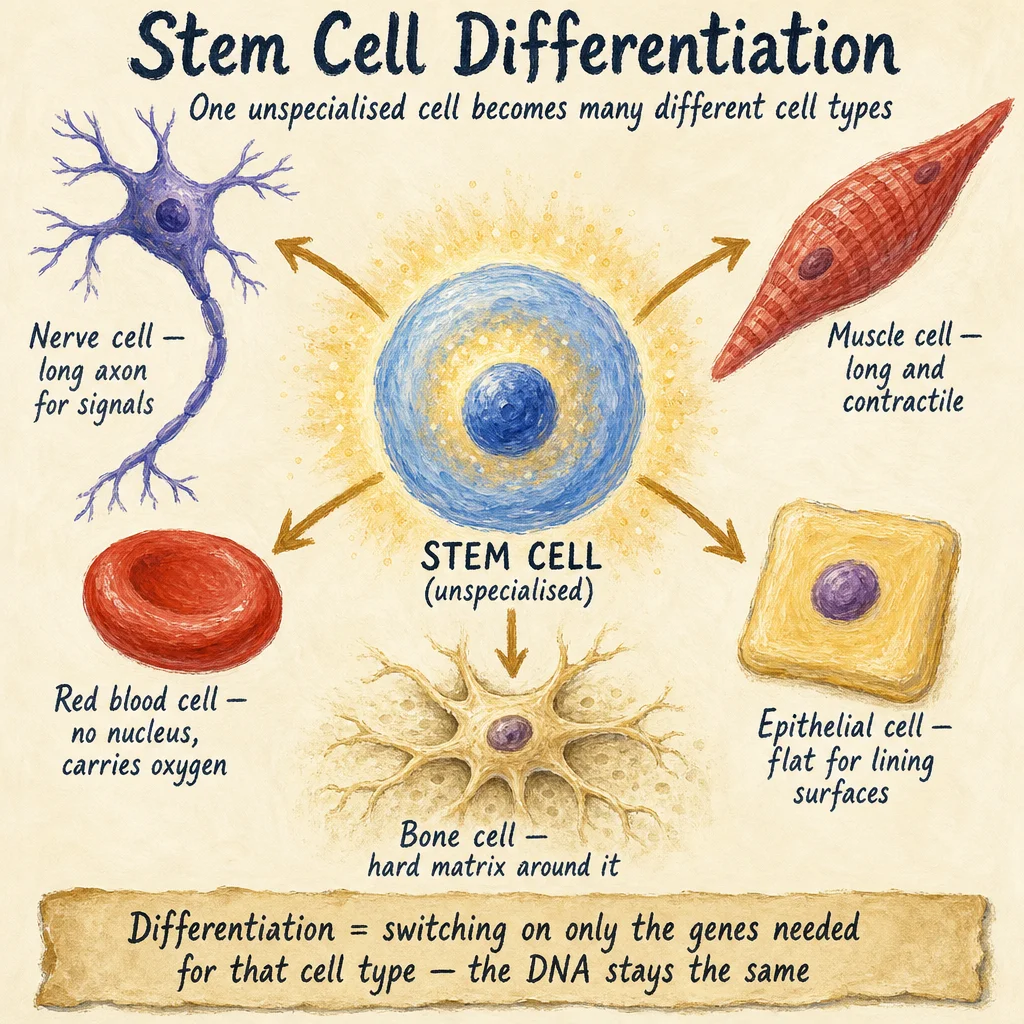
Painted stem cell differentiation hub: a central pale-blue stem cell with golden glow, surrounded by painted arrows leading to multiple specialised cell types (nerve cell with axon, elongated muscle cell, biconcave red blood cell, flat epithelial cell, bone cell).

Figure 1: Stem cells differentiate into specialised cells — embryonic stem cells can form any cell type; adult stem cells are more limited.

Keep building this topic

Read this section alongside the surrounding pages in Stem Cells and Cell Differentiation. That gives you the full topic sequence instead of a single isolated revision point.

Practice Questions for Stem Cells and Cell Differentiation

What is a stem cell?

  • A. An undifferentiated cell that can divide to produce many cell types
  • B. A specialized cell found only in plant roots
  • C. A cell that has already differentiated into a nerve cell
  • D. A bacterial cell that divides by binary fission
1 markfoundation

Explain how sperm cells are adapted for their function.

3 marksstandard

Quick Recall Flashcards

What does 'totipotent' mean?
The highest level of potency - cells can differentiate into any cell type in the organism plus extraembryonic tissues like the placenta. Example: fertilized egg.
What is a stem cell?
An undifferentiated cell that can divide to produce more stem cells (self-renewal) or differentiate into specialized cell types.

20 questions on Stem Cells and Cell Differentiation — practise free

Instant marking, adaptive difficulty, and 25 spaced repetition flashcards. Free until your GCSEs.

Try PrepWise Free