The Story: The Thermostat for Sugar
The Story: The Thermostat for Sugar
Your blood glucose level is like a heating system. If it gets too high (after eating), the "thermostat" (pancreas) turns down the heat — it releases insulin to lower glucose. If it drops too low (not eaten for a while), the thermostat turns up — releasing glucagon to raise glucose. This is classic negative feedback.
Blood glucose regulation. Click each labelled part — islets, insulin action, glucagon and liver, negative feedback loop, and Type 1 vs Type 2 diabetes.
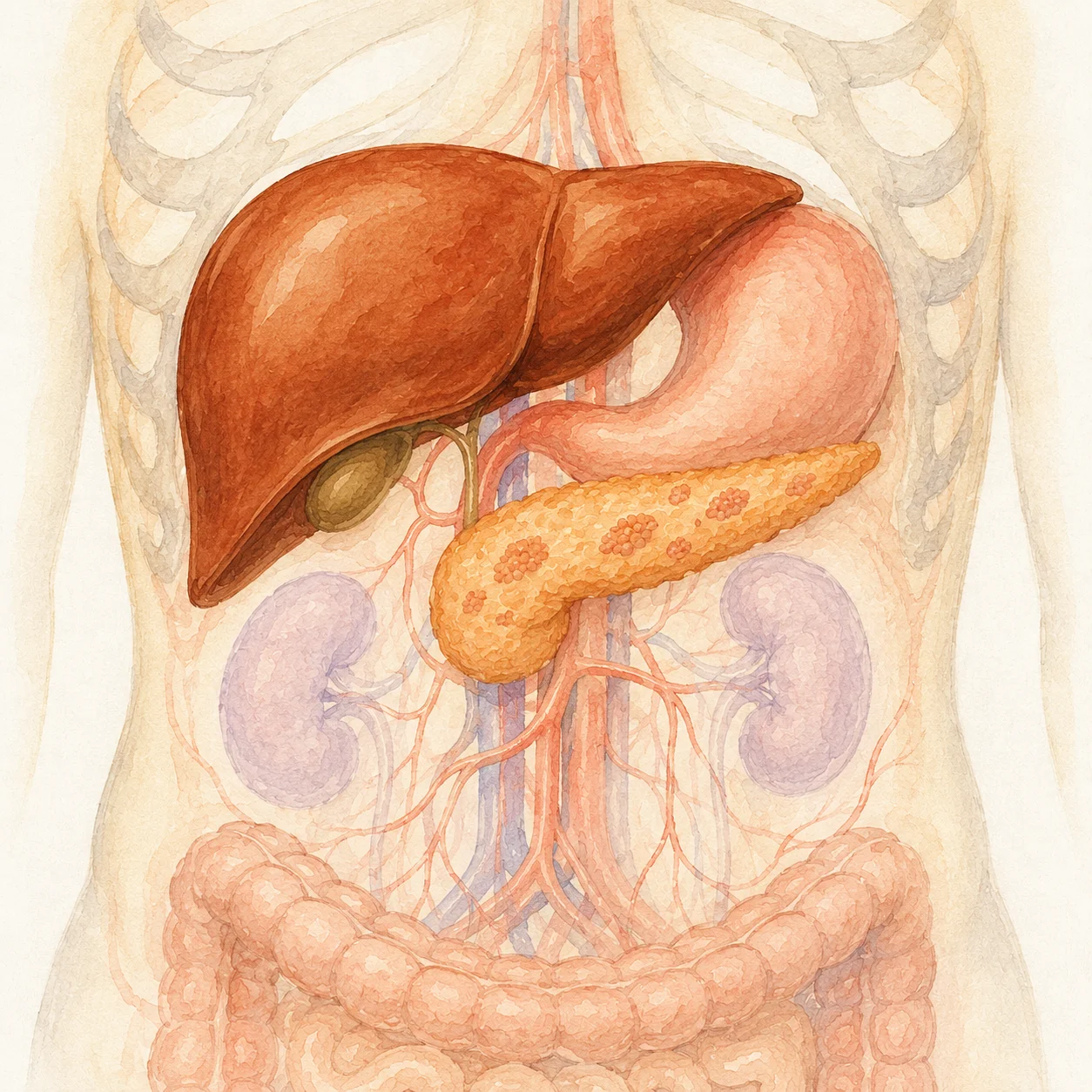
- 1Islets of Langerhans — The control centre — where insulin and glucagon are made.
- 2Insulin action — Insulin: the hormone that lowers blood glucose.
- 3Glucagon and liver — Glucagon: raising blood glucose via the liver.
- 4Type 1 vs type 2 — Two different failures of blood glucose control.
- 5Negative feedback loop — Insulin and glucagon work as opposites in one homeostatic loop.
Figure 1: Blood glucose regulation. Click each labelled part — islets, insulin action, glucagon and liver, negative feedback loop, and Type 1 vs Type 2 diabetes.
Earn the mark scheme marks
Memory Aids
"Insulin = In to cells": Insulin causes glucose to go INTO cells for storage as glycogen. When you see insulin, think of glucose moving inward.
"Glucagon = Gets glucose Out": Glucagon gets glucose out of storage (glycogen → glucose → released into blood).
Alpha and Beta cell locations — "A comes before B":
- Alpha cells → Glucagon (raise glucose — G comes after A alphabetically)
- Beta cells → Insulin (lower glucose)
Type 1 vs Type 2 memory hook:
- Type 1 = No insulin at all — 1 problem: no production. Needs insulin injections.
- Type 2 = 2 things wrong — produces insulin, but cells don't respond. Managed by lifestyle first.
The three G-words to keep straight:
- Glucose — the sugar in your blood (monosaccharide)
- Glycogen — the stored form (polysaccharide, in liver/muscle)
- Glucagon — the hormone that converts glycogen back to glucose
Quick Check: A student eats a large meal rich in carbohydrates. Describe the sequence of hormonal events that return blood glucose to normal, naming the gland, hormone, and the organ acted upon.
After the meal, digestion breaks down carbohydrates into glucose, which is absorbed into the bloodstream — blood glucose rises above the normal range. Beta cells in the pancreas (islets of Langerhans) detect the rise and secrete insulin into the bloodstream. Insulin is transported in the blood to the liver and muscle cells (target organs). Insulin makes these cells more permeable to glucose, so they take up glucose from the blood. Inside these cells, glucose is converted to glycogen (glycogenesis) and stored. As glucose is removed from the blood, blood glucose concentration falls back toward the normal range of approximately 4–7 mmol/L. Insulin secretion decreases as blood glucose returns to normal — completing the negative feedback loop.
Quick Check: Explain why a person with untreated Type 1 diabetes has a persistently high blood glucose concentration even though their cells are starved of glucose for respiration.
In Type 1 diabetes, the immune system has destroyed the beta cells in the pancreas, so no insulin is produced. Without insulin, liver and muscle cells are not stimulated to take up glucose from the blood — the cells remain impermeable to glucose. Glucose accumulates in the bloodstream (hyperglycaemia), producing a persistently high blood glucose concentration. Meanwhile, the body's cells cannot access this glucose for respiration because insulin is needed to allow glucose into cells. The cells therefore become energy-deprived and the body may break down fat and protein as alternative energy sources. This is why Type 1 diabetes requires insulin injections to allow cells to absorb and use glucose.
Quick Check: Compare Type 1 and Type 2 diabetes in terms of cause, which cells are affected, and how each is managed. Use the data in a clear comparative structure.
Cause: Type 1 is an autoimmune condition in which the immune system destroys the beta cells of the pancreas, so no insulin is produced. Type 2 is caused by body cells developing resistance to insulin — they no longer respond normally to it, despite insulin being present. Cells affected: Type 1 affects beta cells (destroyed, so no insulin production); Type 2 affects target cells throughout the body (liver, muscle) which lose sensitivity to insulin. Management: Type 1 requires daily insulin injections to replace the insulin the body cannot make, along with careful blood glucose monitoring and dietary management. Type 2 is managed primarily through lifestyle changes — a low-sugar, high-fibre diet, regular exercise, and weight loss — with medication added if these measures are insufficient. Insulin is rarely needed for Type 2 initially.
Now try it yourself
Quiz · Question 1 of 14
Which organ monitors blood glucose concentration and secretes insulin and glucagon?
Tap an answer to check it
This topic in real past papers
Every real exam question we've found on glucose regulation, with a full worked answer.