Your Body's Lightning-Fast Communication Network
⚡ Your Body's Lightning-Fast Communication Network
Imagine you're walking and suddenly step on a sharp stone. Before you even feel the pain, your foot has already lifted off the ground. How? Your nervous system detected the danger, processed it, and triggered a response — all in a fraction of a second. It's like having millions of tiny messengers sprinting through dedicated highways inside your body, carrying urgent instructions at speeds of up to 120 metres per second. No email, no text message — just pure electrical impulses racing along specialised cells called neurones.
Structure of a motor neurone. Tap any label to explore its function.
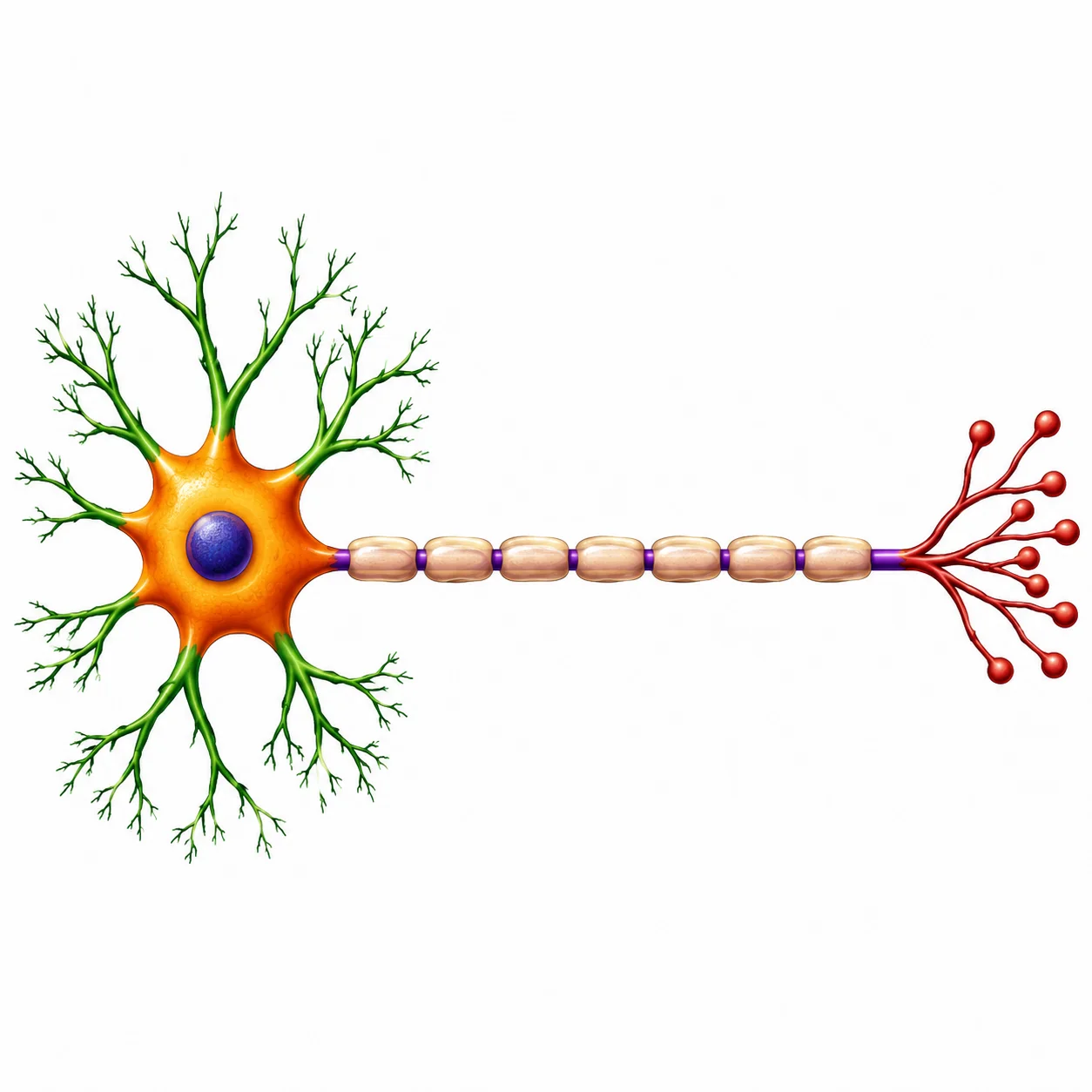
- 1Cell body — Contains the nucleus and most of the organelles — the control centre of the neurone.
- 2Dendrites — Branched extensions that receive signals from other neurones.
- 3Axon — Long thin fibre that carries the electrical impulse away from the cell body.
- 4Myelin sheath — Fatty insulating layer wrapped around the axon — speeds up the impulse.
- 5Axon terminal — Branched endings where the impulse passes to the next cell via chemical neurotransmitters.
Figure 1: Structure of a motor neurone. Tap any label to explore its function.
Earn the mark scheme marks
🧠 Memory Aids
The SRM pathway: "Sensory, Relay, Motor" — information always flows in this order. "Students Revise Methodically" gives you S-R-M in order.
Nervous vs Endocrine:
- Nervous system — Fast, Short-lasting, Specific (FSS)
- Hormonal system — Slow, Long-lasting, Widespread (SLW)
Synapse sequence — "RDBT":
- Release: neurotransmitters released from vesicles
- Diffuse: across the synaptic cleft
- Bind: to receptor proteins on the next neurone
- Trigger: new electrical impulse generated
Direction rule: Sensory = "going TO school" (toward CNS). Motor = "coming home" (away from CNS).
Brain regions — "CCM": Cerebrum (Consciousness), Cerebellum (Coordination), Medulla (Maintenance of heart/breathing).
Accommodation: "Near = Need muscles to Contract" — close objects require active ciliary muscle contraction.
Quick Check: A student touches a hot surface and pulls their hand away before they feel pain. Explain the sequence of events from stimulus to response, naming the type of neurone involved at each stage.
The hot surface is the stimulus, detected by thermoreceptors (pain receptors) in the skin. An electrical impulse travels along a sensory neurone toward the spinal cord. Within the spinal cord, a relay neurone connects the sensory to the motor pathway. A motor neurone carries the impulse from the spinal cord to the muscles of the arm (effector). The muscles contract, pulling the hand away. This is a reflex arc — it is coordinated in the spinal cord without involving the brain, which is why the response happens before the pain is consciously perceived.
Quick Check: Explain why neurotransmitters are needed at synapses rather than the electrical impulse simply continuing from one neurone to the next.
An electrical impulse is an electrochemical signal that travels along the membrane of a single neurone. At the synapse, there is a physical gap between the two neurones — the electrical impulse cannot cross this gap directly. Neurotransmitters are chemical messengers that are released from vesicles at the end of the first neurone, diffuse across the synaptic cleft, and bind to specific receptor proteins on the next neurone. This binding triggers a new electrical impulse in the second neurone. Synapses also ensure signals travel in only one direction (neurotransmitters are only released from the pre-synaptic neurone) and allow the signal to be modulated or stopped.
Quick Check: Describe how the eye focuses on a nearby object. Include what happens to the ciliary muscles, suspensory ligaments, and lens shape.
The ciliary muscles contract, causing the suspensory ligaments to loosen (go slack). Without tension pulling on it, the lens becomes thick and curved. The thicker lens refracts (bends) light more strongly, which is needed to focus light from a close object onto the retina.
Quick Check: In a reaction time experiment, a student's average reaction time improves from 0.28 s to 0.21 s with practice. Suggest two biological explanations for why repeated practice reduces reaction time.
First, repeated practice strengthens the synaptic connections along the neural pathway used for the response — more neurotransmitter receptor proteins may develop on the receiving neurone, making signal transmission more efficient. Second, with practice the brain learns to predict and prepare for the stimulus, meaning the decision-making step in the CNS requires less processing time. The pathway becomes more "automatic", reducing the total time from stimulus detection to effector response.
Now try it yourself
Quiz · Question 1 of 24
What are the two organs that make up the central nervous system (CNS)?
Tap an answer to check it
This topic in real past papers
Every real exam question we've found on nervous system, with a full worked answer.