AlgorithmsDiagram

Flowchart Symbols Reference

Part of Pseudocode & FlowchartsGCSE Computer Science

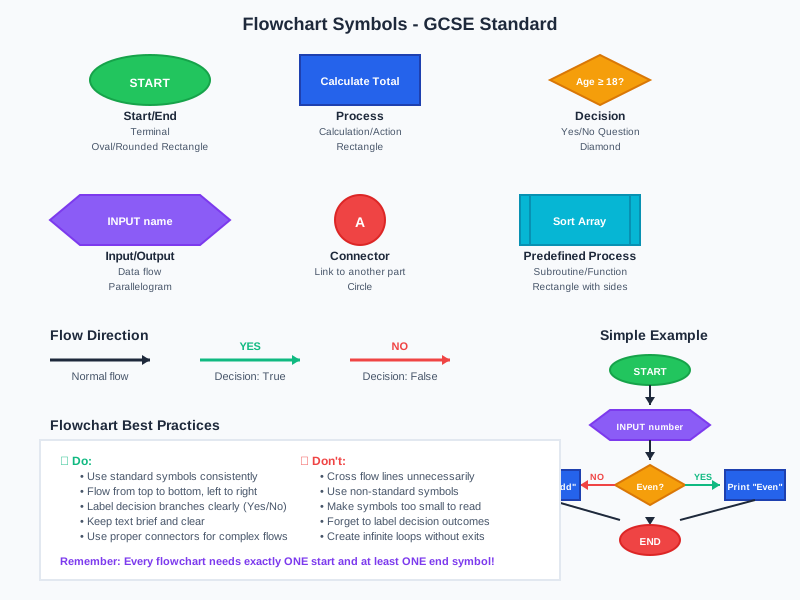
This diagram covers Flowchart Symbols Reference within Pseudocode & Flowcharts for GCSE Computer Science. Revise Pseudocode & Flowcharts in Algorithms for GCSE Computer Science with 15 exam-style questions and 8 flashcards. This is a high-frequency topic, so it is worth revising until the explanation feels precise and repeatable. It is section 3 of 8 in this topic. Focus on the labels, the relationships between parts, and the explanation that turns the diagram into an exam-ready answer.

Topic position

Section 3 of 8

Practice

15 questions

Recall

8 flashcards

Flowchart Symbols Reference

Flowchart symbols reference diagram showing all standard flowchart shapes: oval/terminator for Start and End, parallelogram for Input and Output, rectangle for Process or Calculation, diamond for Decision (Yes/No branch), and arrows showing flow direction, with example text in each shape

Keep building this topic

Read this section alongside the surrounding pages in Pseudocode & Flowcharts. That gives you the full topic sequence instead of a single isolated revision point.

Practice Questions for Pseudocode & Flowcharts

Which flowchart symbol is used to represent a decision?

  • A. Rectangle
  • B. Diamond
  • C. Oval
  • D. Parallelogram
1 markfoundation

Describe three features that should be present in well-written pseudocode for a counting loop.

3 marksstandard

Quick Recall Flashcards

What is a trace table?
Table to track variable values during execution
What shape is used for Start/End?
Oval (terminator)

Want to test your knowledge?

PrepWise has 15 exam-style questions and 8 flashcards for Pseudocode & Flowcharts — with adaptive difficulty and instant feedback.

Join Alpha