AlgorithmsDiagram

Trace Table Example

Part of Trace TablesGCSE Computer Science

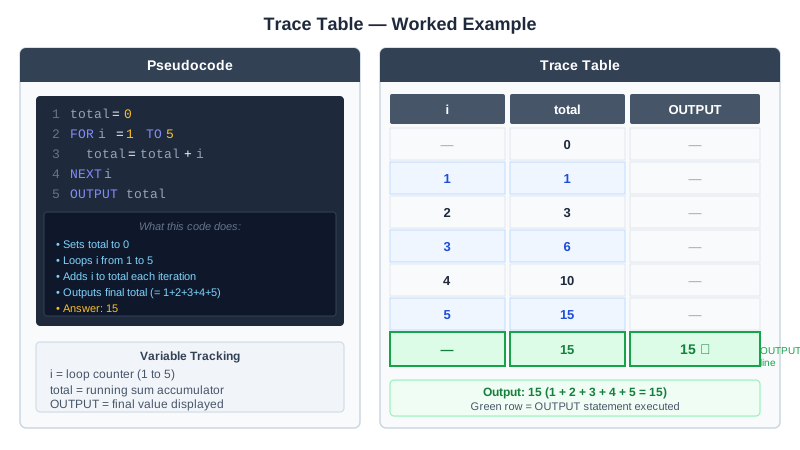
This diagram covers Trace Table Example within Trace Tables for GCSE Computer Science. Revise Trace Tables in Algorithms for GCSE Computer Science with 15 exam-style questions and 8 flashcards. This topic appears regularly enough that it should still be part of a steady revision cycle. It is section 3 of 7 in this topic. Focus on the labels, the relationships between parts, and the explanation that turns the diagram into an exam-ready answer.

Topic position

Section 3 of 7

Practice

15 questions

Recall

8 flashcards

Trace Table Example

Trace table example diagram showing a FOR loop algorithm with columns for loop variable i, a running total variable, and any output, with each row showing the values after each iteration, demonstrating how to track variable changes step by step through an algorithm

Keep building this topic

Read this section alongside the surrounding pages in Trace Tables. That gives you the full topic sequence instead of a single isolated revision point.

Practice Questions for Trace Tables

What is the main purpose of a trace table?

  • A. To write pseudocode more quickly
  • B. To track how variable values change as an algorithm executes
  • C. To convert pseudocode into Python code
  • D. To measure how fast an algorithm runs
1 markfoundation

Explain how a programmer uses a trace table to test an algorithm. Your answer should refer to variables and errors.

3 marksstandard

Quick Recall Flashcards

What does != mean?
Not equal to
What is pseudocode?
Language-independent algorithm description using English-like syntax

Want to test your knowledge?

PrepWise has 15 exam-style questions and 8 flashcards for Trace Tables — with adaptive difficulty and instant feedback.

Join Alpha