Memory & StorageDiagram

Storage Types Comparison

Part of Secondary StorageGCSE Computer Science

This diagram covers Storage Types Comparison within Secondary Storage for GCSE Computer Science. Revise Secondary Storage in Memory & Storage for GCSE Computer Science with 15 exam-style questions and 18 flashcards. This is a high-frequency topic, so it is worth revising until the explanation feels precise and repeatable. It is section 2 of 10 in this topic. Focus on the labels, the relationships between parts, and the explanation that turns the diagram into an exam-ready answer.

Topic position

Section 2 of 10

Practice

15 questions

Recall

18 flashcards

Storage Types Comparison

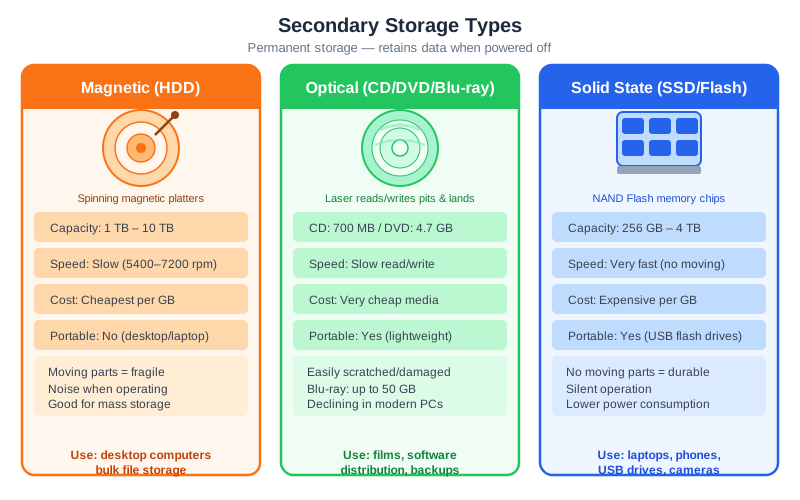
Secondary storage types diagram comparing magnetic hard disk drives (spinning platters, read/write head), solid state drives (NAND flash chips, no moving parts), and optical storage (CD/DVD/Blu-ray laser reading pits and lands), with speed, capacity, and cost comparisons

Keep building this topic

Read this section alongside the surrounding pages in Secondary Storage. That gives you the full topic sequence instead of a single isolated revision point.

Practice Questions for Secondary Storage

Which of the following is a characteristic of secondary storage?

  • A. Data is lost when the computer is switched off
  • B. Data is retained when the computer is switched off
  • C. It is faster to access than RAM
  • D. It is only used to store the operating system
1 markfoundation

Describe how data is stored on a magnetic hard disk drive (HDD).

2 marksstandard

Quick Recall Flashcards

Want to test your knowledge?

PrepWise has 15 exam-style questions and 18 flashcards for Secondary Storage — with adaptive difficulty and instant feedback.

Join Alpha