Memory & StorageDiagram

Binary Place Values and Conversion

Part of Binary & HexGCSE Computer Science

This diagram covers Binary Place Values and Conversion within Binary & Hex for GCSE Computer Science. Revise Binary & Hex in Memory & Storage for GCSE Computer Science with 15 exam-style questions and 22 flashcards. This topic appears regularly enough that it should still be part of a steady revision cycle. It is section 2 of 14 in this topic. Focus on the labels, the relationships between parts, and the explanation that turns the diagram into an exam-ready answer.

Topic position

Section 2 of 14

Practice

15 questions

Recall

22 flashcards

Binary Place Values and Conversion

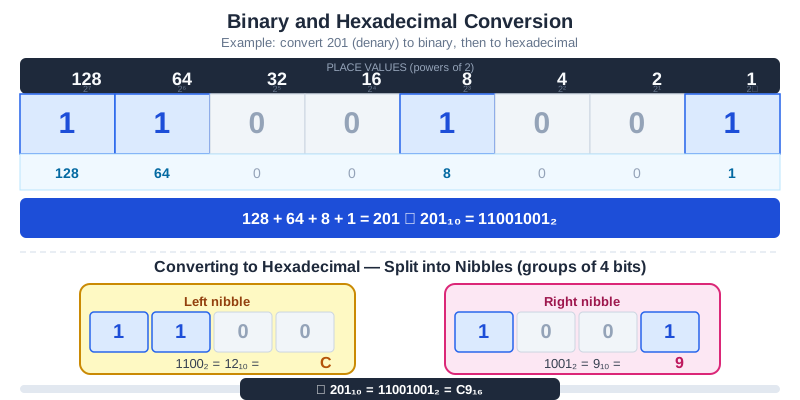
Binary place value diagram showing an 8-bit number with place values 128, 64, 32, 16, 8, 4, 2, 1 from left to right (MSB to LSB), with an example conversion of denary to binary and hexadecimal showing the 4-bit grouping shortcut

Keep building this topic

Read this section alongside the surrounding pages in Binary & Hex. That gives you the full topic sequence instead of a single isolated revision point.

Practice Questions for Binary & Hex

Which of the following correctly describes the hexadecimal number system?

  • A. Base 2, using digits 0 and 1
  • B. Base 8, using digits 0 to 7
  • C. Base 16, using digits 0-9 and letters A-F
  • D. Base 16, using digits 0-9 and letters A-G
1 markfoundation

Explain why hexadecimal is used instead of binary when programmers write memory addresses and colour codes. Give three reasons.

3 marksstandard

Quick Recall Flashcards

Want to test your knowledge?

PrepWise has 15 exam-style questions and 22 flashcards for Binary & Hex — with adaptive difficulty and instant feedback.

Join Alpha