Binary search is like guessing a number between 1 and 100 when the friend only says "higher" or "lower". You do not start at 1. You guess 50, and every answer lets you throw away half of the numbers. Binary search does the same on a sorted list: check the middle item, decide which half the target must be in, discard the other half, and repeat.
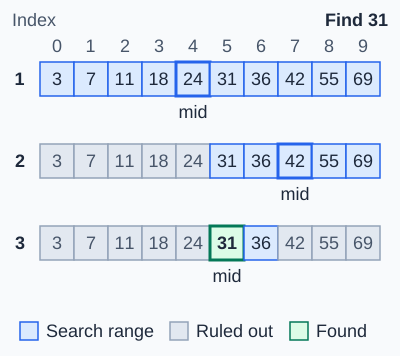
Binary search needs a sorted list. Each check looks at the middle of the search range, then rules out the half that cannot hold the target. Here 31 is found in 3 checks. The most checks grow very slowly: 10 items need at most 4 checks, and 1,000,000 items need at most 20.
This introduction covers Finding Something Fast within Binary Search for GCSE Computer Science. Revise Binary Search in 3.1 Fundamentals of Algorithms for GCSE Computer Science with 15 exam-style questions and 10 flashcards. This is a high-frequency topic, so it is worth revising until the explanation feels precise and repeatable. It is section 1 of 8 in this topic. Use this introduction to connect the idea to the wider topic before moving on to questions and flashcards.
Practice questions for Binary Search
Which of the following is a requirement before binary search can be used?
Describe how a binary search algorithm finds a target value in a sorted list.